When Love Refused to Flee: John at the Cross, Peter the Shepherd, and the Blessedness of Persecution
The Passion narratives present a striking and often misunderstood contrast between fear and fidelity, silence and witness, flight and love. Among the Twelve, only one disciple is named as present both at the judicial proceedings against Christ and at the foot of the Cross: John. If you are one of those who have been troubled by this fact, this article is for you; especially in light of John’s admitted familiarity with the household of the High Priest who condemned Jesus, and the later persecution of apostles by the same religious authorities. Yet when the Gospel accounts are read together with the Beatitudes, the apostolic mission after Pentecost, and the witness of the early Church Fathers, a coherent theological picture emerges — one in which love explains John’s presence, and in which fear is not erased but transformed by grace.
In the Gospel according to St. John, we read that “Simon Peter followed Jesus, and so did another disciple. And that disciple was known to the high priest, and went in with Jesus into the court of the high priest” (John 18:15). The Evangelist is characteristically discreet. He does not name himself, yet the unanimous testimony of the ancient Church identifies this “other disciple” as John. Origen, Chrysostom, Augustine, and later commentators all accept this identification without controversy. John’s admission into the courtyard is not presented as a mark of favor toward Jesus, nor as a sign of safety. Rather, it is a simple historical note: he was known to the household and therefore permitted entry.
St. John Chrysostom addresses this passage directly, noting both the danger and the motive involved. Commenting on this scene, he writes: “But the wonder was that matter of Peter, that being in such fear, he came even as far as the hall, when the others had retreated. His coming there was caused by love, his not entering within by distress and fear. For the Evangelist has recorded these things, to clear a way for excusing his denial; with regard to himself, he does not set it down as any great matter that he was known to the high priest, but since he had said that he alone with Jesus went in, lest you should suppose that the action proceeded from any exalted feelings, he puts also the cause.” (Homily 83 on the Gospel of John). Chrysostom’s observation is crucial. John’s access is not explained by political protection or moral neutrality, but by providence, and his perseverance by love. Fear still exists, but it is not sovereign in him.
This distinction between fear and love is precisely what Christ Himself had already articulated in the Sermon on the Mount. “Blessed are they that suffer persecution for justice’ sake: for theirs is the kingdom of heaven” (Matthew 5:10). The Beatitudes do not deny the reality of persecution; they declare its paradoxical blessedness. To be persecuted for Christ is not to be abandoned by God, but to be conformed to the Son. The early Church consistently understood this beatitude as an interpretive key for apostolic suffering.
Cyprian of Carthage, himself martyred in 258, echoes the same theology: “The Lord desired that we should rejoice and leap for joy in persecutions, because, when persecutions occur, then are given the crowns of faith, then the soldiers of God are proved then the heavens are opened to martyrs. For we have not in such a way given our name to warfare that we ought only to think about peace and draw back from and refuse war, when in this very warfare the Lord walked first — the Teacher of humility, and endurance, and suffering — so that what He taught to be done, He first of all did, and what He exhorts to suffer, He Himself first suffered for us” (Epistle 55.3). Thus, when the apostles flee in Gethsemane, Scripture does not excuse them, but neither does it condemn them as apostates. It reveals their humanity, which grace will later perfect.
This humanity is seen most clearly in Peter. He follows Christ into the courtyard, yet denies Him three times. John enters without denial, yet does not speak publicly. Silence and denial are not the same, but both arise from fear. Love alone determines the future of each man. John’s love keeps him near; Peter’s love, though wounded, keeps him from despair.
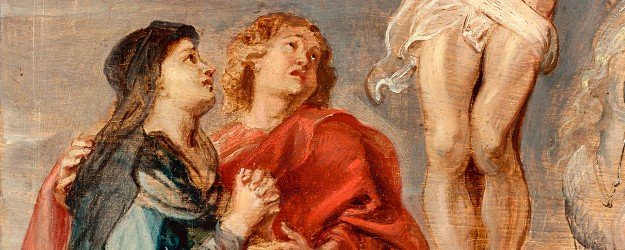
At Calvary, the contrast sharpens. The Synoptic Gospels tell us that the apostles were absent, scattered in fear. St. John alone records the presence of “the disciple whom He loved” standing by the Cross, together with Mary, His Mother (John 19:25–27). This moment is not merely historical; it is ecclesial. Jesus entrusts His Mother to John, and John to His Mother, forming the nucleus of the Church gathered beneath the Cross. The others will return later, but here love has drawn one disciple into the heart of redemptive suffering.
St. Augustine reflects on this scene with theological clarity: “He provided in some measure another son in place of Himself. And why He did so, He indicates in the words that follow: for the evangelist says, “And from that hour the disciple took her unto his own, speaking of himself. In this way, indeed, he usually refers to himself as the disciple whom Jesus loved: who certainly loved them all, but him beyond the others, and with a closer familiarity, so that He even made him lean upon His bosom at supper; in order, I believe, in this way to commend the more highly the divine excellence of this very gospel, which He was thereafter to preach through his instrumentality.” (Tractate 119 on John). Augustine’s interpretation harmonizes perfectly with the Johannine theology of love. “Perfect charity casts out fear” (1 John 4:18), not by denying danger, but by reordering the soul.
This reordering becomes explicit after the Resurrection, and definitive after Pentecost. In John 21, the risen Christ restores Peter with three questions that mirror his three denials: “Simon, son of John, lovest thou me?” Each affirmation of love is followed by a command: “Feed my lambs . . . feed my sheep.” Love is made the condition of pastoral authority. Fear is not mentioned; love alone qualifies Peter for shepherding.
From that moment onward, Peter acts not as a forgiven coward, but as the Vicar of Christ in action. On the day of Pentecost, he stands publicly in Jerusalem and proclaims the risen Christ. Scripture tells us that “there were added in that day about three thousand souls” (Acts 2:41). This is not accidental symbolism. The man who once denied Christ before a servant girl now confesses Him before the nations. Fear has not vanished, but it no longer governs him.
When Peter and John are arrested in Acts 4, they stand together before the Sanhedrin — the same body that condemned Christ. Yet the outcome is radically different. They are threatened and released, not executed. The text explains why: “Seeing the boldness of Peter and John . . . and knowing that they were illiterate and ignorant men, they wondered” (Acts 4:13). The authorities fear the people more than the apostles fear death. The timing of martyrdom belongs to God, not to human courts.
This restraint, however, does not last indefinitely. Later persecutions claim the lives of many apostles. James the son of Zebedee is executed by Herod Agrippa (Acts 12:2). James the Just, the brother of the Lord, is stoned under the high priest Ananus around A.D. 62, as recorded by Josephus (Antiquities 20.9.1). The apparent inconsistency dissolves once we understand that persecution unfolds according to providence, not uniform policy.
John himself, according to universal tradition, is not martyred but exiled. Tertullian records that he was plunged into boiling oil at Rome and emerged unharmed, after which he was banished to Patmos (Prescription Against Heretics, chapter 36). His survival is a sign that his witness was reserved for a different form of testimony: the Apocalypse.
Finally, the continuity of this apostolic witness is affirmed by St. Irenaeus, Bishop of Lyons, writing around A.D. 180. Against the Gnostics, he appeals to the public succession of bishops, especially at Rome: “The blessed apostles, then, having founded and built up the Church, committed into the hands of Linus the office of the episcopate . . . to him succeeded Anacletus; after him, Clement . . . and to this Clement there succeeded Evaristus, Alexander, Sixtus, Telesphorus, Hyginus, Pius, Anicetus, Soter, and now, in the twelfth place from the apostles, Eleutherius holds the inheritance of the episcopate” (Against Heresies 3.3.3).
Irenaeus’ testimony matters because he was only one generation removed from the apostles, having learned from Polycarp, the disciple of John. The same John who stood at the Cross transmitted a faith in which love conquers fear, persecution confirms truth, and apostolic authority flows not from power, but from fidelity unto suffering.
In this light, the Gospel narratives are not contradictory but profoundly unified. John’s presence at the trial and the Cross is not explained by privilege, but by love. Peter’s denial is not the end of his vocation, but the prelude to his shepherdhood. The Beatitude of persecution is not poetic consolation, but historical reality. And the Church that emerges from fear into witness is the same Church that continues, through apostolic succession, to proclaim Christ crucified and risen — until the end of the age.
What remains, then, is to see how these strands — John’s fidelity, Peter’s transformation, persecution as beatitude, and apostolic continuity — cohere not merely as historical facts but as a single theological testimony. The New Testament does not present courage as the absence of fear, but as fidelity purified through fear. John does not appear immune to danger; rather, he remains because love binds him more firmly to Christ than fear can drive him away. Peter does not begin as fearless; he becomes steadfast because love, forgiven and confirmed, is entrusted with responsibility.
The Beatitudes illuminate this dynamic from the beginning. Christ does not say, “Blessed are those who escape persecution,” but “Blessed are they that suffer persecution for justice’s sake.” The blessedness lies not in the suffering itself, but in the union it creates between the disciple and the Master. This is why the early Church never interpreted persecution as a sign of divine abandonment. On the contrary, it was read as confirmation of authenticity. Tertullian’s famous dictum — “the blood of the martyrs is the seed of Christians” — is not rhetorical exaggeration, but a theological conclusion drawn from the Gospel itself. The Church grows not by safety, but by fidelity.
John’s presence at the Cross is therefore not an anomaly but a paradigm. He stands where fear would dictate flight, not because he calculates the risk differently, but because love has reordered his priorities. This is precisely why Christ entrusts Mary to him. The disciple who remains becomes the guardian of what is most precious. The Church Fathers consistently interpret this moment ecclesially: John represents the faithful disciple who abides, Mary represents the Church, and the Cross is the place where both are joined. Fear scatters; love gathers.
Peter’s role complements, rather than contradicts, this witness. His denial is not erased from the narrative because it is essential to his mission. The shepherd of the flock is not chosen for flawless courage, but for humbled love. When Christ asks him three times, “Lovest thou me?”, He does not ask, “Were you brave?” or “Did you stand firm?” Love, not nerve, is the criterion. From that moment on, Peter’s leadership is visibly transformed. In Acts, he speaks first, he judges first, he suffers first. His authority is exercised publicly and at cost. This is why the early Church could see in Peter not merely an apostle among others, but the visible principle of unity, acting as vicar of Christ in the concrete life of the Church.
Irenaeus’ testimony anchors this theological reading in history. By enumerating the bishops of Rome from Peter onward, he demonstrates that apostolic authority did not dissolve with persecution, nor did it rely on secrecy or esoteric knowledge. It endured publicly, sacrificially, and traceably. The same Church that stood beneath the Cross stood before emperors and tribunals. The same logic prevailed: fear threatened, love sustained.
Even John’s long life, often contrasted with the martyrdom of the others, fits this pattern. The tradition never interprets his survival as preferential treatment. Rather, it is vocation. Some glorify God by dying swiftly; others by bearing witness patiently. John’s exile, his suffering, and his final testimony in the Apocalypse all proclaim the same truth: Christ reigns, and fidelity endures. The Lamb who was slain is victorious, and those who follow Him “whithersoever He goeth” do so by love.
In the end, the Gospel accounts, the Beatitudes, and the Fathers speak with one voice. Fear is real. The apostles felt it. The Church has always felt it. But fear does not have the final word. Love does. John did not flee because love held him fast. Peter did not fail forever because love restored him. The persecuted are blessed because love unites them to Christ. And the Church remains because love, once crucified, is also risen.