In Consideration of The Good
By Dcn. Peter Trahan, MATh
Part I – The Transcendentals
In considering the good, we are reflecting on one of the three principal transcendentals: Truth, Goodness, and Beauty. Unlike the three Theological Virtues that we receive through Baptism, Faith, Hope, and Charity, the transcendentals are absolute, objective qualities of reality. The Virtues guide us and order us to God. They give us foundational certainty upon which our faith journey, our relation to God, is grounded.
The transcendentals, on the other hand, are the framework of being. St. Thomas Aquinas quotes Augustine, who says, “In as much as we exist, we are good.” (S1, Q5, a1) Before we reflect more deeply on goodness, let’s see how the three transcendentals are related, to each other and to being.
Aquinas goes on to say, “Goodness and being are the same and differ only in idea.” Then quoting Aristotle, he says, “Goodness is what all desire. The essence of goodness is that it is in some way desirable.”
Being and goodness are the same, but as goodness is desirable, it makes the thing desirable. With this we can say, being is not without goodness. Hence, a framework. If we call upon St. Thomas again, we hear this:
Beauty and goodness in a thing are identical fundamentally; for they are based upon the same thing, namely the form. Consequently, goodness is praised as beauty. But they differ logically, for goodness properly relates to appetite [it is desirable]. . . On the other hand, beauty relates to the cognitive faculty; for beautiful things are those which please when seen. (S1, Q5, a4, ad 1)
Goodness is desirable, beauty is pleasing. Similar but different. When you look upon the Mona Lisa, its beauty is pleasing, but is it desirable? Yet, it is, therefore it is good, and therefore desirable, but in what way? Although you don’t desire to possess it, you are drawn to its goodness in a way which moves you to want to see it again or learn more about it. It is desirable in these ways, but to desire and to covet are not the same.
In regard to truth in relation to good and being, Aquinas says:
As good has the nature of what is desirable, so truth is related to knowledge. Now everything, in so far as it has being, so far [also] is it knowable. . . And therefore, as good is convertible with being, so [also] is the true. (S1, Q16, a3, resp)
At this point we can affirm our original assertion, that the principal transcendentals, Truth, Goodness, and Beauty, are qualities of being.
All things that are, have these ontological qualities. Experience tells us, however, that not all things are pleasing to the eye or desirable. So, do things vary in degrees of these qualities?
The answer is “yes.” This variance factor is proper to participation. The transcendentals are not given, as the virtues are; they just are. If being has these qualities, then Being itself, God, is their source. They are convertible attributes of God. God is Love, God is Mercy, God is Truth, Goodness, and Beauty. Creation participates in the Being of God. This participation varies according to the accidents of a thing, but not their essence. If a thing is not pleasing to see, it is because the outward appearance does not (fully) express the beauty of its being.
Thomas says the following on how truth is a participation:
Truth resides primarily in the intellect; and secondarily in things, according as they are related to the divine intellect. . . If we speak of truth as it is in things, then all things are true by one primary truth; to which each one is assimilated according to its own entity.
He goes on to say,
The true and being are convertible terms. Hence, just as being is not generated or corrupted of itself, but accidentally, in so far as this being or that is corrupted or generated. (S1, Q16, a6, resp)
Here, Thomas confirms that truth (and other transcendentals) are in things as a participation in the ultimate truth, goodness, and beauty, which is God. Things express these qualities more or less (generated or corrupted) “according to [their] own entity.” In other words, regarding a particular thing, it more or less expresses beauty. This thing expresses beauty more or less than that thing, although they are of the same essence (e.g. this rock vs that rock). The variance is a variance of expression rather than variance of the qualities themselves.
The variance of good or beauty, but what of truth? How can a thing be more or less true? Thomas and others — Bishop Robert Barron, for instance — uses these common examples of varying truth. 2 + 2 = 4 and God is Love are both true propositions, but the former has less significance. God is Love reflects the nature of God; it participates more fully in God who is Truth.
Turning now to the good in particular we may ask, “What is it about this thing that makes it desirable?” St. John Paul II would say it is value. In his article in Communio “The Lived Experience of Value, in the Act of Faith,” John Paul makes a relational distinction between good and value. The good of a thing is intrinsic to its being and is expressed in varying degrees by its actual presence, its accidents. It is these characteristics that make the thing desirable, it has value. This is the distinction that John Paul refers to; a thing is good, and it has value. Value is that which the thing expresses that would be favorable or beneficial to the subject. The goodness is objective, but the value is subjective. E.g. some people don’t like chocolate cake; it has no value for them; but that doesn’t make it less good.
Part II – Virtue
Before we move on, we should look at virtue as a good. Virtue is good behavior, that is to say, to act in an ethical or moral manner. Romano Guardini, in his book Learning the Virtues That Lead You to God, asks the question, “What does it [virtue] mean?” He replies, “It means that the motives, the powers, the actions, and the being of man are gathered at any given time into a characteristic whole by a definitive moral value, an ethical dominant, so to speak.” Virtue, he says, “denotes something living and beautiful.”
Virtue extends through the whole of existence, as a harmony which gathers it into unity. [. . .] It is from the eternal goodness of God that moral enlightenment comes into the soul of the receptive man. [. . .]
It imparts to different characters their respective dispositions for good. The good is a living treasure, radiating from God, at its source infinitely rich and yet simple, but breaking up and unfolding at its contact with human existence. (p. 11)
It seems that Guardini is presenting virtue as, or similar to, a transcendental in so far as it “extends through the whole of existence.” If we look closely, however, there is a subtle shift in describing virtue.
“It is from the eternal goodness of God that moral enlightenment comes into the soul of the receptive man.’ It is from the transcendental good, i.e. from God. Virtue is distinguished from its source in as much as it is from its source (Good/God). Virtue is moral enlightenment that comes into the soul,” from the Good that is God. This is important going forward, to understand that virtue is a fruit of goodness rather than a transcendental in itself. That it “extends through the whole of existence,” indicates that it is not something produced by certain actions, rather it is always there, as it is radiated from the good, which is eternal. Virtue is something available to the receptive person, based on natural receptivity or intentional discipline, depending on the person’s disposition for good. Final note on virtue: it is a good specific to human persons. As mentioned above, things are desirable to the degree that they express their innate good. Virtue, as a good, pertains specifically to human enrichment, and therefore enrichment of the human community.
Part III – Things of Creation, Things of the World
The goodness within a person is the same goodness found in creation, and it is the same goodness found in the world. In all cases, goodness connects us to God. Everything that is good, is a participation in The Good which is God. “Lord, through your Son Jesus Christ, you bestow on the world all that is good.” (cf. Eucharistic Prayer III)
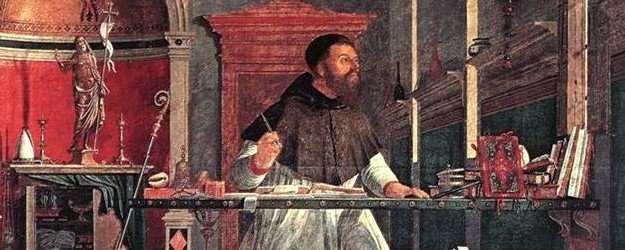
In his conversion and supplication to God, St Augustine turned away from the things of the world that were contrary to God. However, the more his love for God grew, he realized that the things of the world were things of God, and the goodness of God can be found in the creation and in the world. The things of the world, and of creation, he realized, were not contrary to God; rather, it is the misuse or excess that is contrary, or partaking of them as an end in themselves. God created creation for man; the temporal order in the Order of Love. This is a significant pillar of Augustinian spirituality, along with unity and community, finding the Creator through His creation. To completely shun the material world would not be pleasing to God.
“But what is it that I love in loving you?. . . I love a certain kind of light and sound and fragrance and food and embrace, in loving my God, who is the light and sound and fragrance and food and embracement of my inner man. . . . This is what I love when I love my God.”
“I admire all this, I sing of it, but I still thirst for the one who made all this.”
“Use [uti] well the things here below, and you will correctly enjoy [frui] the good from above.”
This binomial uti / frui — for using things as a means — is a foundation of Augustinian ethics. [Author]
“These inferior values have their delights,” but as means in the ordo amoris, in the order of love that always tends toward God.
This is St Augustine’s vision: see creation, see God. It evokes spontaneous gratitude and joy.
Part IV – Good Person
“In the beginning God created the heavens and the earth.” (Gen 1:1)
And He pronounced it “good,” “very good.”
“All things came to be through him, and without him nothing came to be.” (Jn 1:3)
From Genesis, God created and it was good, and after creating man, male and female, He said, it is very good. They were very good. The word good is not used again to describe a person until we hear it from Jesus. The just man is prominent in the Old Testament, especially in the Psalms, but a just man is definitively distinct from a good man. A just man is focused on justice, righteousness, and moral integrity; he is oriented toward the law and fairness. A good man is focused on kindness and generosity, and is oriented toward love and compassion. A man can be a just man, and not a good man, but a good man is always a just man. The idea of a good person emerges in the teachings of Jesus.
“Just so, every good tree bears good fruit, and a rotten tree bears bad fruit. A good tree cannot bear bad fruit, nor can a rotten tree bear good fruit.” (Mt 7:17–18)
“A good tree does not bear rotten fruit, nor does a rotten tree bear good fruit. For every tree is known by its fruit.” (Lk 6:43)
Luke, however, follows v. 43 with v. 45, which gives us a different perspective.
“A good person, out of the store of goodness produces good, but an evil person out of a store of evil produces evil.” (Lk 6:45)
Jesus uses the analogy of good tree, good fruit, rotten tree, rotten fruit as ideals in His teaching. When we apply them to persons, we immediately see the flaw of Original Sin. Sometimes a good person produces bad fruit. The passage, Luke 6:45, is more comforting in that “a store of goodness” implies a filling of the store, and a diminishing of the store, which corresponds to man’s striving for virtue and holiness. Exterior and interior distractions can diminish our store of virtue and holiness, while prayer, sacraments, and service build up again. It is a store of Grace.
In personal reflection or spiritual direction, we may focus initially on the bad fruit that we have produced in our life and extrapolate back to the tree. I don’t think that is what Jesus intended with His metaphor of the trees. We should, instead, focus on the “store of goodness” and discern the good that has been accumulated and ways to build it up. If there are good fruits, there must be a store of goodness in the person. The person is more or less an expression of good in correlation to the store of goodness.
The store of evil, St Augustine would say, is the empty portion of the store. “Evil is the privation of good where good ought to be.” When the privation is larger than the remaining good, the likelihood of bad fruit is prominent.
We must be vigilant in filling the store with goodness. We are always “more or less” an expression of goodness according to our store of grace. Our accidents are our works; “you will know them by their fruit.” (Mt 7:16)