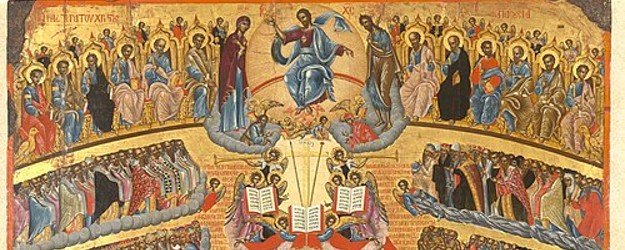
The Solemnity of All Saints – November 1, 2026
Readings: Revelation 7:2–4, 9–14 • Psalm 24:1bc–2, 3–4ab, 5–6 • 1 John 3:1–3 • Matthew 5:1–12a
bible.usccb.org/bible/readings/110126.cfm
“How do I love thee? Let me count the ways.” Many of us are probably familiar with this line which begins a poem by Elizabeth Barrett Browning, but as beautiful as it may sound, most of us can probably also quickly see it is not exactly ideal dating advice. For anyone who has been in a relationship can tell you, as much as it is nice to try and list someone’s good qualities, inevitably such a list ends with a stutter and a “well there’s so much more!” Or the indignant question “Is that it?” Are ten qualities enough to capture why we love someone? Twenty? Any list can feel woefully inadequate in comparison with the depths of our feeling. And that is because love, like most things, loses its mystery when it becomes calculable and determinate. If we only love someone for certain aspects of themselves — does that mean we stop loving them if something changes, if those qualities for some reason fade? Rather we love someone for who they are, as an infinite mystery that cannot be captured by any sort of academic essay, which is perhaps why we so often turn to poetry to express love.
And this makes sense if we reflect on what it means to say that God is love. As much as we experience love here on earth, as much as we can love one another to some extent, true love is something divine and eternal. It’s something that unites the Father, Son, and Holy Spirit, in ways far beyond our understanding. Fortunately for us though, that divine love took on flesh so that we could experience it in a way we could understand: in our Lord Jesus Christ. Christ became man to clearly show us the true nature of love, which is to lay down one’s life for others. Love is not a feeling that comes and goes, it is the commitment to seek the good of another, even if it costs us. Christ shows us this love in the most perfect way, to the point that we need four gospels which all describe it differently, leaving it still open to further reflection and prayer. All the books in the world could not capture the extent to which Christ loves us, in what could be described as the dramatic poetry of the cross.
In trying to imitate His love, then, all of us inevitably fall short, because His love is truly divine. Yet we are called to do so as best we can, and that is what we celebrate today on this great Feast of All Saints. Because what do we celebrate but those people, just like us, who in some particular way shared in the love of Christ, who in their own way lived out a love of God and neighbor which lifted them up to eternal life. No saint could live out fully that perfect love Christ showed, but each stands almost as a bullet point in an endless list of illustrations of what love is meant to be. Some gave their lives as martyrs like the young Roman girl St. Agnes and the concentration camp prisoner St. Maximilian Kolbe. Some lived hidden lives of prayer and contemplation, like the monk St. Benedict and the humble Carmelite St. Thérèse of Lisieux. Some lived radical poverty and simplicity like the great Saints Francis and Dominic. Some traveled across the globe, preaching the Gospel, like the twelve apostles and St. Francis Xavier. Each saint serves as another Gospel, another poem, another perspective that captures one of the infinite facets of the invaluable gem of Christ’s love.
This feast, then, should give us great comfort and encouragement, because for many of us, doubtlessly the thought of becoming holy can seem out of reach. How could we ever live such a perfect love? How could we ever live out all the virtues in such a radical and perfect way? Yet we celebrate that this is not what is asked of us; rather, it is just that we live out the particular holiness God has in mind for us, that we love in the particular way our vocation and situation asks of us. Not all of us are meant to be martyrs, or monks, or missionaries, but we can be holy accountants and architects, husbands and wives, neighbors and coworkers. We can live out the beatitudes of today’s Gospel, that serve as starting point of the infinite list of things that makes a saint. We can, in our own simple way, live out Christ’s love in whatever small corner of the world we find ourselves, so that we too can be another representative of Him to the world.
As we look then today to Christ, who is the light of the world, we can think of the saints as refractions of his pure white light into the infinite colors of the spectrum. While no color could ever match the perfect beauty of His light, taken together the saints become a brilliant reflection of the love Christ brought into the world. Each of them came to the altar, opened their hearts to Christ, especially here in the Blessed Sacrament, so that with Him in their hearts they too could be the light of the world. May the same be true of us. At the end of our lives, when we stand before God and say to Him, “How do I love thee? Let me count the ways,” may our lives be less like a checklist, and much more like a love poem.
The Commemoration of All the Faithful Departed (All Souls) – November 2, 2026
Readings: Wisdom 3:1-9 • Psalm 23:1-3a, 3b-4, 5, 6 • Romans 5:5–11 or Romans 6:3–9 • John 6:37–40
bible.usccb.org/bible/readings/110226.cfm
In Rome, there’s a very unusual Capuchin church known for its crypt. When the friars took over the church centuries ago, they brought the bones of their deceased brethren from their prior location, which comprised thousands of skeletons. With such a glut of material, one of the friars was inspired to exercise his artistic talent by using those bones to decorate the crypt. So he created chandeliers out of pelvises, frescos from ribs and vertebrae, and skulls cover the walls like the wallpaper of an angsty teenager’s bedroom. The site has become something of a legend, if a macabre one at that. Because for most people, there is obviously something unsettling about finding yourself in a room filled with human bones, even if they are arranged in a cheery way. There is something uncomfortable about coming face to face with death so dramatically. Though that is exactly the intention of the friars, to give a memento mori, a reminder that we will someday die. It is something that becomes clear as you leave, because at the end there is a sign that reads, “What you are now, we once were; what we are now, you shall be.” A stark reminder of what awaits us all.
It is a bit like what we celebrate here today in the Church, in the Commemoration of All Souls. After yesterday’s celebration of all the saints who triumphed with Christ over sin and death so as to reign gloriously in heaven, we pause to pray today for all those who have died without that honor. It may seem natural to us, but to many in our world, it is a celebration just as incomprehensible as that bone crypt. Because in our times we so often try to sanitize death, hide it away in hospitals, or even worse coordinate it and plan it with the horrors of euthanasia and physician-assisted suicide. It has become the practice to have a celebration of life for the dearly departed, and then to try not to think so much about the great questions that such a moment brings: What next? Why are we here? To what purpose do we live? We quickly go back to our routines, keeping busy, running between work and mindless activity, especially with technology, so that we never have to really confront the reality of death.
The beauty of our Catholic faith, though, is found exactly in moments like these where we show that we have come to terms with death, that we do not fear death. We are unafraid to come face to face with the fact of death that waits for us all, because we have hope, because we have Christ. What is the Good News, if not the promise that Christ died and rose from the dead so that we may live? Is not one of the most common phrases of the Scripture: “Be not afraid”? Our faith is all about giving us confidence that this life is not the end, but a new beginning. That our time on earth has a purpose, and it is to come to know, love, and serve God in this life so that we may with Him forever in the next. As we reflect on all those who have passed on from this world, all those we love who are no longer with us, we find comfort in the fact that we have a God who loved us enough to die for us and save us from sin and death.
Today’s commemoration leaves us, therefore, with a twofold challenge. First, we must ask ourselves how comfortable we are with death. Of course there will always be a fear in us of the unknown, of having to face death which brings with it the possibilities of pain and dejection, but does that fear ultimately give way before our love and trust in the Lord? As much as we may experience a human fear, as our Lord did in the Agony in the Garden asking, “Let this cup pass from me,” like Him we are also called to say, “Not as I will, but as you will,” knowing that whatever God wills is ultimately our path to eternal life. Today puts before us the death of all the faithful departed, not to scare us, but to remind us that our primary responsibility in life is to prepare for the end by putting ourselves in God’s hands so that fear does not have the final say.
A second element of today, though, is a reminder to pray. While yesterday we celebrated those men and women like us whom we know to be at peace in eternal life interceding for us, today we remember that many of us will die far from being perfect like the saints. Again though, we find comfort, knowing that we can pray for those who are going through purification after this life, just as others will be able to pray for us when we endure the same. The dead can no longer do penance for their sins, but the living can, and so we are all called as brothers and sisters in Christ to make offerings for them as a great spiritual work of mercy. Whether it is offering a Mass for them or lifting them up to God in prayer as we remember them with love, we give them a gift which comforts them and speeds them on their way to be with the saints in heaven.
While it may seem a bit dark then, to gather in the Church and reflect on all those who have died, we as Catholics find in today nothing but hope. We are reminded that with Christ who has conquered death, we need no longer fear. We are reminded of the promise that if we live and die united with Him, we will rise united with Him, and God willing just as we pray for the dead, we can be confident others will pray for us too when our time comes. Today, we face down death, and more than anything else we pray that the words of those Capuchin monks may be in the mouths of those in heaven, “What you are now, we once were; what we are now, you shall be.”
Thirty-Second Sunday in Ordinary Time – November 8, 2026
Readings: Wisdom 6:12–16 • Psalm 63:2, 3–4, 5–6, 7–8 • 1 Thessalonians 4:13–18 or 1 Thessalonians 4:13–14 • Matthew 25:1–13
bible.usccb.org/bible/readings/110826.cfm
Most of us can probably remember many of the cliches and expressions which were drilled into us as children to teach us valuable lessons. We can perhaps think of “Haste makes waste,” or “Many hands make light work,” and of course, “Sharing is caring.” This last one in particular is important, especially for small children, for one of the first words a child tends to learn whether in dealing with siblings or friends is “mine!” Sure, we can debate about whether the right to private property is natural to human beings, but it is undeniable that children do their best to stake a claim on what is theirs lest someone take it from them. They so often see the world as a zero-sum game, where someone else’s gain inevitably entails their loss. Regretfully, though, all too often, this mindset is not exactly one that fades in adulthood. We can all fall into the habit of resentment when something goes well for someone else, as if it costs us, and we can be hesitant to share our own good fortune, lest it leave us deprived of what we have won or earned.
At first glance, this can very much seem to be the sin of the wise virgins of today’s Gospel. The foolish virgins did not bring enough oil and so ask the wise virgins to share, but the wise refuse, in fear that there might not be enough for everyone — something that would get them failing marks in a pre-K classroom. We can almost feel sorry for the foolish virgins, as the wise are let into the wedding feast and rejoice with the bridegroom, while the foolish are locked out, and are told, “Amen, I say to you, I do not know you.” As much as this can be our first impression, though, it falls short of grasping what the parable is seeking to reveal, because of course the virgins and the oil are symbolic of something far deeper.
For what does the oil symbolize, but something that is essentially not shareable: a relationship with Christ. The wise virgins, in preparing for the bridegroom, have spent their lives gathering such “oil.” They have lived lives of prayer, of service, of virtue. They have grown in a holiness that allows them to be open to the Lord when He comes, anxious to greet Him and celebrate with Him. While the foolish virgins have squandered the gift of their lives and not gathered this oil. They have spent their lives on worldly pursuits, striving to fulfill sensual desires and achieve temporal success. To the point that when the bridegroom arrives, they have no oil, because He is a stranger to them. They have not spent their lives preparing for His arrival, so He comes as one unexpected and unwelcome. What then can the wise virgins share with them? Is it possible to share virtue? To share a relationship? To share holiness? These are goods of our soul which as much as we may like to, we cannot give to another.
Today’s Gospel, therefore, offers us a two-fold reminder. First, when we stand before God, we will ultimately have to take responsibility for our own souls. Each of us comes from varied backgrounds, we have been subject to different influences for better or worse, and yet each of us has the freedom to choose to prepare for Christ or not. Each of us must open our hearts to Christ and choose Him in prayer, in love of God and neighbor, or else He will be a stranger to us. As St. John Henry Newman wrote in one of his sermons, only the holy go to heaven, because someone who has no relationship with God would not be happy in heaven, as heaven is just like being in church and worshipping God forever. No one else can share with us their faith, good works, or love. We will be judged according to our own lives.
Second, though, we are also reminded that as much as we cannot share our own spiritual riches, they are not a limited resource. As opposed to a zero-sum game where my gain is another’s loss, we can very much share our faith with others by inviting them to open themselves to the infinite riches we have discovered. By witnessing to the Gospel in our lives with joy, by showing others the value of the spiritual “oil” we accumulate through a life united with Christ, enriched by the sacraments and emptied of selfishness and pride, we very much share what we have received by helping others to pursue that same end for themselves. Unlike most worldly goods which we might want to hold back for ourselves lest they be taken from us, a relationship with Christ only becomes richer the more it is shared, as every Christian builds up the body of Christ, the Church, and makes the Kingdom of God even more substantially present in our broken world.
So today we are challenged, first, to take seriously our own call to holiness. When we get to the end of our days, there will be no phone-a-friend—except perhaps the saints who intercede for us. We will be asked whether we have lived a life that testifies to the fact that we want to be in heaven. Second, and very much related, part of that testimony will be that we not only lived for Christ, but that we also shared Him with others. We think of the words of our Lord, “Whatever you did for one of these least brothers of mine, you did for me,” and realize it is more than just the corporal works of mercy, but also the spiritual works that help others grow closer to Him. Especially here at the altar, we are reminded that just as the Eucharist does not become any less Christ when it is broken, so too when we break and share Christ with others, He only fills more hearts with His light and His joy.
Thirty-Third Sunday in Ordinary Time – November 15, 2026
Readings: Proverbs 31:10–13, 19–20, 30–31 • Psalm 128:1–2, 3, 4–5 • 1 Thessalonians 5:1–6 • Matthew 25:14–30
bible.usccb.org/bible/readings/111526.cfm
“The most powerful force in the world is compound interest.” This line is often, if probably falsely, attributed to Albert Einstein. Whether he said it or not, though, it does point to something quite remarkable. If you invest money with interest and allow it to grow without taking anything out, the rate at which it grows will increase exponentially, as you will come to make interest on the interest. In reality, this is of course not quite as glamorous as it sounds, as if you invest money somewhere perfectly safe, like a bank savings account at 0.5% interest, it will take somewhere around 150 years for you to double your money. But I remember as a kid realizing how this works and being amazed that money just kind of grows by itself. Not only money but other things too, just of themselves, increase in value over time, like a fine wine, an antique, or many collectibles (except beanie babies).
This concept very much helps illuminate today’s Gospel, which can often challenge us a bit. We have servants who are given talents by their master, and two put them to good use and increase them. The third, however, in his great caution, buries his talent lest he loses it. And when the master returns, this cautious servant responds defensively. He pretty much accuses the master of being demanding and “harvesting where he did not plant,” which is to say taking more than his due, such that in fear he buried the talent. The master, though, makes a simple observation in response: all you had to do was put it in the bank, and it would have made interest!
This passage can often be misinterpreted as implying that we have a demanding God, and that unless we do certain things and fulfill God’s requirements, God will be disappointed. He can seem like the great taskmaster in the sky with a clipboard, ready to catch us. Yet how far is this from the truth? Because what is the point of the Gospel, except to teach us that the master, God, is the one who gives us talents — all that we have and all that we are — undeservedly. And the gifts He gives us are not some burden; they are not something that demands a great deal of us; rather they bring forth fruit of themselves if only we let them. The grace God gives us is no different than compound interest. If we let God invest in us, if we open ourselves to Him, the holiness in us will grow, often in spite of us, as God will work through us in ways beyond our imagining. And it is not as though God “harvests where He did not plant,” because He rather rewards those who allow this growth to happen by giving them more. When the harvest is rich, he plants all the more. It is only the one who in fear and lack of trust buries his talent that receives nothing.
For us, then, we are reminded of a simple truth of the spiritual life. Holiness is not about jumping over certain hurdles; it is not a checklist; it is not living up to some arbitrary standards God has set for us. We are not meant to cower in fear that we might mess up and be punished by God’s wrath. Holiness is rather turning to God in love and trust, allowing Him to guide our lives according to His providential plan. Yes, it requires us to do certain things — pray, frequent the sacraments, sacrifice, love God and neighbor — but these are not burdens but gifts. These are the things that will bring true holiness and allow us to become who we are meant to be. It is only pride that refuses God’s grace for fear of what it may require of us, so that we bury the grace given to us in baptism and never allow it to bring forth fruit in the world.
So today we are reminded that we have been given many talents by the Lord. We have been given life, health, family, and all else, not because we have in any way deserved them, but because God in His great goodness freely brought us into being. And even though we so often reject that love in sin, He has given us His Son on the cross to die that we may live. It is not just that we deserve nothing, but we really deserve punishment, and yet He makes this great sacrifice that we may be forgiven and raised up to new life in grace to share in divine love. Most especially here at Mass though, we take part in that sacrifice and are given the great gift of the Eucharist, the Body and Blood of Christ which nourishes our souls and makes it possible for us from day to day, week to week, year to year, to become saints. The Eucharist truly is the gift that compounds in our souls. By staying in a state of grace and receiving at least every week, the divine life in us grows exponentially, so that we can carry out greater acts of love and grow in both the holiness and the happiness God intends for us.
The Solemnity of Our Lord Jesus Christ, King of the Universe – November 22, 2026
Readings:
There is a chain of gyms that has made a name for itself with the slogan: a Judgment Free Zone. For many people that may not be a big deal, but for those of us on the less athletic side, we can be all too familiar with the feeling of watching and being watched by athletic people at a gym, and it is not great. As you put on the light weights which seem heavy to you, it is easy to imagine others laughing to themselves. And as they step in and put on double the weight, it is not exactly a boost for self-esteem. So it is good that we have places where we can freely try to improve ourselves without feeling judged. And yet, as great as this idea may be, when we look at the world around us, we realize things may have gotten a little out of hand in this regard, because now the whole world seems to have become a no judgment zone. The times in which we live are remarkable in that there is very little which people would be willing to admit is objectively bad — maybe smoking or eating saturated fats — so that morally each person is encouraged to live their own truth, to just be themselves, to make their own rules. We can determine our own gender, our own sexual ethics, our own code of truth and goodness. Maybe even more so as Americans, that is our whole idea of freedom: liberty is pursuing happiness as we would like, as long as we do not hurt anyone. Right and wrong is not a matter of judgment, it is a matter of preference.
Hearing today’s Gospel though, it might seem a little challenging to most contemporary people, because what do we see: our Lord Jesus Christ, King of the Universe, Savior and Redeemer, sitting upon his throne executing judgment upon humankind. Sweet, nice, loving Jesus who would never judge us or deny us what we want, very clearly sending the goats who did not serve Him to eternal punishment. We see that Christ has a standard, a set of norms by which He will judge those worthy of eternal life, and we are warned that He will make use of them when the end comes. It may seem a bit harsh, but it is important that we pause and realize—well, what exactly would it mean to call Christ our King, unless this were true?
Because the trouble today is that we want to be our own kings; we want to be our own gods. We want to be able to decide who we are, what we should be, and how we should live. We see ourselves as a blank slate to be formed by our own desires. It is very American: I want complete liberty; I do not need a king telling me what to do. And yet our faith teaches that the opposite is the case. We were made by someone else, and He is the one who determines who we are and what we were made for. Like a knife is made with a sharp edge for cutting, and a chair is made with a flat surface for sitting, each of us was made for a particular purpose, and to do otherwise would be like a fork deciding it wants to be a spoon; it is to rebel against our very selves. God made us for Himself; He made us to live in imitation of His Son in perfect love, and He gave us clear guidelines for how to live that out so that we could be with Him in eternal life. He did not make us for perfect happiness here in this life. He made us so that in this life we could choose Him by our actions and so choose eternal happiness with Him in the next life.
And what makes this undeniably obvious is that the more people live their own truth and try to judge for themselves what is right and wrong, the less happy they are. We have never lived in a more comfortable and secure time, and yet there has perhaps never been more anxiety and depression and emptiness. Our world pushes us to chase our deepest desires, and we realize those desires are scattered and without purpose. We go in a million directions and wake up one day having gone nowhere and become no one. We chase all sorts of stuff, and when we get to the other end of the race, we find only sorrow. Yet Christ knows the recipe for happiness; He lives it and He tells us in the Gospel: care for the least of His brethren, care for Him. It is what makes us good people like sharp points make good pencils, but we have to surrender to it. Like flowing water, which on a flat surface just pools up and stagnates but with boundaries and direction flows, so too with us, God gives the channel, rules, and direction, and within them we are able to rush to our goal of happiness. It is only when we surrender to those boundaries and accept His direction that we can carve out our Grand Canyon or run to our great waterfall or form the beautiful rivers and lakes we are called to.
Our simple question today then is to ask: Is Christ truly my King? Do I accept Him as my judge, or am I my own judge, my own god? Am I ready to accept His guidance for me, His direction, His code of right and wrong, or do I prefer to make my own? If we struggle in giving an honest answer, we are challenged to surrender to God and strive to learn what He is calling us to and how He wants us to live. Because we know He is not some cruel king, but rather a King of love whose throne is the cross and whose crown is of thorns. In seeing Him lay down his life for us, we are given more than enough reason to trust that what He asks of us will ultimately bring us true happiness.
So I am not going to lie to you today and tell you the Church is a judgment free zone, because it is not. Sure, we will never judge each other for our failings, we will never judge each other for the weaknesses we have and the mistakes we make, but we judge actions as right or wrong so that we can strive to fix them. We look to the eternal judge to know what right and wrong is, so that we can help each other grow in the holiness and happiness He calls us to. Today, we lay down our lives before the merciful Judge and King and know that when we stand before him some day, while He will meet the proud and willful like a lion, He will meet the humble like a lamb ready to welcome them into His eternal home.
Thanksgiving
How beautiful is it that we, as Americans, set aside a day solely for giving thanks. Above all, because we certainly have a great deal to be thankful for. While the world and our nation are still filled with suffering and poverty and division, few societies have lived with the level of peace and prosperity we enjoy. A day like today forces us to pause and take stock of that fact, as it is something we can so often take for granted. The question we have to ask, though, is who we are really thanking. Gratitude is meaningless unless it is directed toward someone who has done some good for us. So we can think of, for example, the soldiers who have made great sacrifices, or the statesmen who have served honorably, or the everyday people who have committed themselves to civic life in a way that has kept the American dream alive. But even then, there is only so much we can thank such figures for. Each may have played some part in handing on to us what we have today, but there is still so much more. Whether it be the food we will share in exceptional quantities, family and friends, life and health. There is so much we have that goes beyond what anyone of flesh and blood could ever give.
Which is of course why, above all, we give thanks today to almighty God. This is something that might be controversial in a world that tries to be strictly secular, keeping God out of the public square, but Thanksgiving really falls short unless we give thanks to the one who is ultimately the source of all the good that we have. As G.K. Chesterton once put it as he reflected on his road to conversion, “I felt grateful, though I hardly knew to whom. Children are grateful when Santa Claus puts in their stockings gifts of toys or sweets. Could I not be grateful to Santa Claus when he put in my stockings the gift of two miraculous legs? We thank people for birthday presents of cigars and slippers. Can I thank no one for the birthday present of birth?” When it comes to so many of even the most basic gifts that we have received and we feel grateful for, the only one we can possibly thank is God.
And this gratitude so often serves as the great dividing line between those who are perpetually unhappy and those who live joyfully. Because on the one hand, if everything we have is a gift, if everything we have comes from someone like God, if everything we have is undeserved, then everything we have will ultimately be a source of wonder. How incredible is it that this God, who owes us nothing, has decided to give us so much? What joy to live in a world where every sunrise, every breath, every moment we have with someone we love is an undeserved gift we can relish. While on the other hand, without such gratitude, we all too often start to think these things are owed to us, so that when we lose them, we become resentful and angry. We live with the mantra, “That’s not how it’s supposed to be,” and constantly resent all that we do not have, rather than appreciate all that we do have. It is something we can see so clearly in difficult times, how people of gratitude are appreciative in their sorrow for the time they had with whom or what they lost, while those without gratitude only get frustrated that they have been deprived of something owed to them.
This dichotomy is found most clearly when we come to the greatest gift we can ever receive, and that is our Lord Jesus Christ. The greatest and most undeserved gift is found in the Incarnation, in the fact that God so loved us that He gave His only son to die on the cross that we may be forgiven our sins and live with Him forever. We could never deserve this gift, and yet God offers it to us. Now, it is possible to reject this gift, and that is by thinking we deserve it. When we try to take eternal life for ourselves, when we insist that we are good enough or deny that our sins are sins, we refuse the gift of God’s mercy to us. Accepting this gift is really the easiest thing in the world, though, because all we need to do is embrace it with gratitude. Just as we show gratitude for the gift of a sweater by wearing it, or a gift card by spending it, so too we show gratitude for this greatest gift of salvation by putting it to good use and allowing it to transform us into the saints God made us to be. More than that, we show our appreciation by sharing it with everyone. If this infinitely great gift, which brings joy and peace and the promise of eternal life, is free for the taking, how could we not want to extend it to all.
Gathered here at Mass then, especially on this day but every time we are here, we come to give thanks to God. We celebrate the Eucharist, which literally means Thanksgiving, by uniting ourselves with Christ who offers the perfect sign of gratitude in offering Himself to the Father. In receiving the Eucharist, the Blessed Sacrament, we receive that great gift of our Lord Jesus Christ Himself, which feeds our souls infinitely more than any Thanksgiving feast could ever feed our bodies. Christ comes to us and gives us the gift of salvation, if only we are humble enough to accept it with gratitude.
First Sunday of Advent
The contrast between what is happening here in the Church and out in society today could not be any starker. On the heels now of Thanksgiving, everyone around us has gone into full Christmas mode. Perhaps even from before Thanksgiving, lights and decorations are up, the music is blasting, the holiday hustle is already well on its way, with only 25 shopping days until Christmas, and only 16 until Beethoven’s birthday. Calendars fill up with parties and concerts and everything else that goes into this season, so that most people are already feeling the stress of somehow fitting it all in. And yet what do we find here? Purple vestments, we do not sing the Gloria, and in the first reading we hear, “Behold, you are angry and we are sinful; all of us have become like unclean people…we have all withered like leaves, and our guilt carries us away like the wind…You have hidden your face from us and have delivered us up to our guilt.” Not exactly the stuff of Christmas carols, though perhaps more fitting to the time of year. As we see the world grow darker, as nature seems to lose its life and the leaves fall, we are given a striking image for what this season in the Church is all about.
Because what do we reflect on in Advent, but the darkness of the world without Christ. As a season of anticipation, of longing for Christ’s coming, rather than celebrate, we embrace a more somber tone. Especially in these first weeks, we do not even focus on Christ’s coming as a child, but we focus on the second coming at the end of time. We are called to repent and prepare for our judgment: “Be watchful! Be alert! You do not know when the time will come…May he not come suddenly and find you sleeping.” As the world goes dormant in winter, we reflect on the winter of our own lives and ask ourselves if we are prepared for the coming of Christ. Even if we are young, we are reminded that we do not know the day nor the hour, but we must always be prepared by seeking to keep Christ at the center of our lives. Rather than be content and enjoy the world, we are called to look at all the evil and suffering and realize that in so many ways, Christ’s building of the Heavenly Kingdom in this world has only just begun. We are reminded that we live for heaven and Christ’s final coming because any joys in this world are always temporary and mixed with sorrow, unlike the perfect joy of the world to come.
We also, though, do begin to reflect on that first coming of Christ, to grow in a greater appreciation of how radically transformative His Incarnation really was. Because the world without Christ truly was a far darker place. We think of how today we take such good care of the marginalized and outcast, how we are concerned with the sick and the poor, how we fight against the idea that might makes right. But it is only with Christ and His message of love that any of these ideas become predominant. It is why so many so quickly converted to the faith in spite of persecution, it is why so many throughout history have been willing to go to their deaths as martyrs for their Christian faith, because they realized without it, this life becomes quite bleak. Christ alone gives us meaning and purpose, He alone teaches us what our lives are about and how we become what we are meant to be, and He alone gives us a supernatural dignity which can elevate us above all the awful things humanity is capable of.
What should we all do, then, if we want to have a “good Advent,” and take advantage of this season of grace the Church offers us. First, we have to take seriously the idea that this is not a season of celebration, but preparation. If we spend the next four weeks acting as if it is already Christmas, we will miss the whole point of taking time to think about how much we need Christ in our lives and how lost we would be without Him. This does not mean we have to be dark and maudlin for the month, but maybe we hold back on some indulgences we normally enjoy in this season. We allow ourselves to feel a bit deprived, so that we experience a longing which should only be a shadow of the longing we feel for Christ.
Second, we should use this season as a time of more intense prayer. While much of the celebrating can be unavoidable because of the culture around us, we can still try to set aside extra time to be with God. In prayer we can take time to reflect on how blessed we are to have Christ in our lives. We can ask ourselves what our lives would be like without Him, and how lost we would be. We can examine too the ways we try to keep God out of parts of our lives, especially in those sins we hesitate to let go of, realizing that if only we let Him in it will be for our own happiness.
Above all, though, here at Mass, we can prepare our hearts to welcome the Lord more deeply, both at Christmas and at the end of our lives. As we look into our hearts, we ask ourselves if we have made them a worthy dwelling place for the Lord. We think of both the Infant Jesus as well as the Lord of Glory, and we ensure that our hearts are a worthy crib to give Him shelter and a worthy throne from which He can rule us. Each time we receive the Blessed Sacrament here at Mass, we strive to prepare ourselves more and more, so that when the Lord does come, we are truly ready to welcome Him.